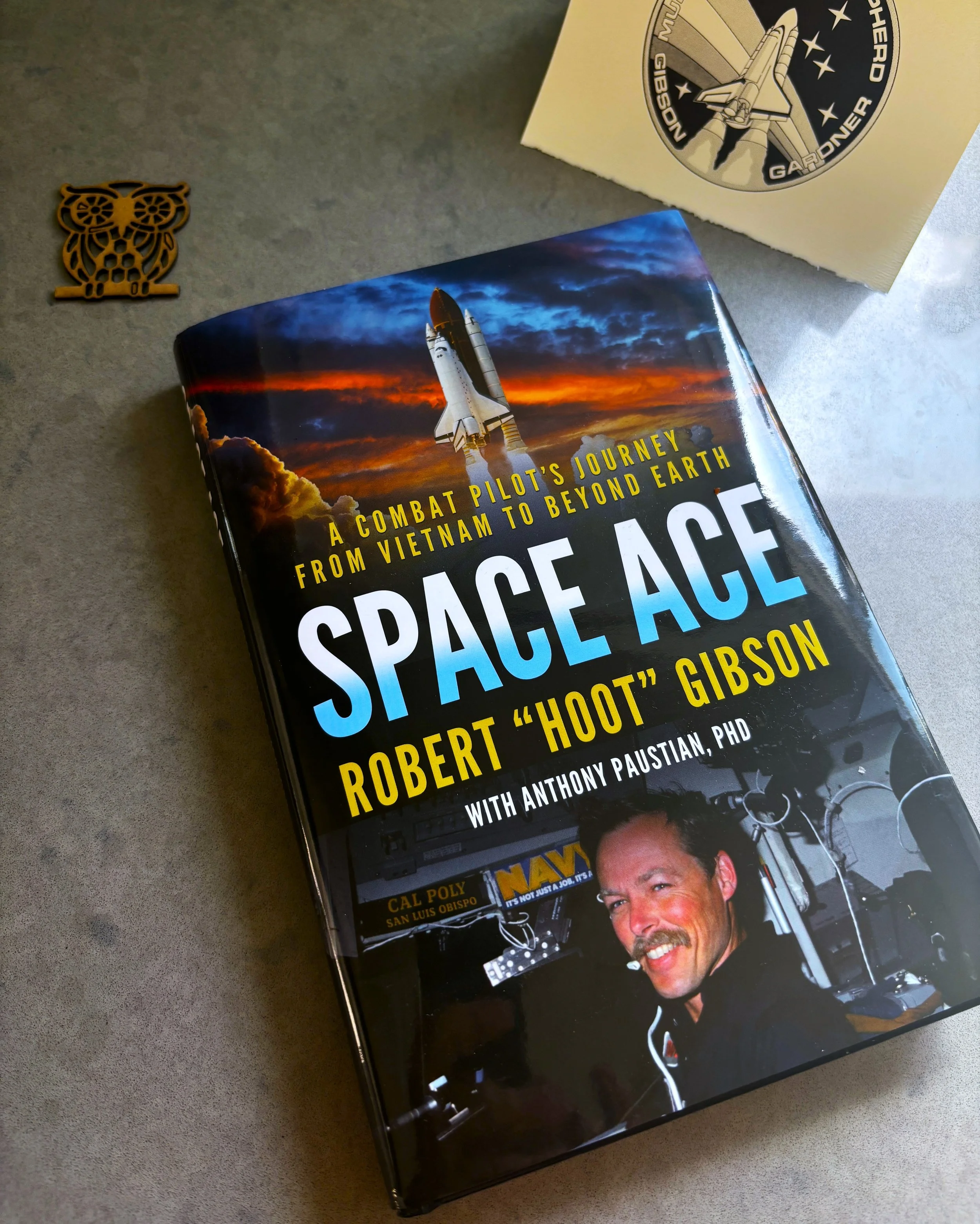
A Pilot, Momentarily Distracted by the Space Program...
/Space Ace: A Combat Pilot’s Journey From Vietnam to Beyond Earth, Robert “Hoot” Gibson with Anthony Paustian, 2026
Those in the aviation world know Hoot Gibson’s story well – a rich career including time served in fighter squadrons, as a combat aviator, a Top Gun graduate, and a test pilot. That’s enough of an incredible career in itself. But that was just the beginning for Hoot. That all took place before what he’s known for best – a NASA astronaut.
Hoot flew five shuttle missions, four of them as commander. He took one of the twentieth century’s most iconic photographs, of astronaut Bruce McCandless flying untethered in space. It was the photo every 1980s kid had on their wall. He landed a space shuttle despite it having such severe tile damage, it could have burned up. In 1995, the first time an American spacecraft docked with a Russian space station, Hoot commanded the American side and nailed the docking.
All of these iconic space moments are covered in this book. But it’s clear that’s not what grabs Hoot the most about his life. The book could be titled Anyway, Back to Airplanes… because any time Hoot talks about other moments in his life – his undiagnosed ADHD as a kid, his close family life, in fact pretty much anything other than airplanes – it’s engagingly told yet feels like a sideline to what he really wants to talk about. Clearly he’s madly in love with the feeling of flying jets, prop planes – anything he can hurl off a runway – and this passion comes through on almost every page. It stretches back into his youth, as a child of pilots. Even if you’re not an aviator yourself, you’re drawn in by his enthusiasm.
I was one of those kids with the McCandless poster on my wall, and so I was drawn to his descriptions of the early shuttle years. Hoot was there as NASA learned what it took to fly the shuttle. Reading this book brought back memories of trying to record snippets from the British evening news on our family VCR, watching the fuzzy footage from orbit of that remarkable era. Now, through Hoot’s words, I have learned more from his insider viewpoint. We’re there with him as he helps talk a shuttle down to land as a chase pilot, seeing it shoot by his jet almost head-on. This is a perspective few ever experienced, never mind shared.
There are things that, even if you know someone, you don’t ask them. I was aware that, in the early 90s, Hoot had been involved in an air race accident that left another pilot dead and a reprimand issued by NASA. It’s not the kind of thing you bring up in conversation. But in this book, Hoot doesn’t avoid the subject, clearly explaining what happened with his typical candor. I appreciate his honesty.
I’ve hosted Hoot on an astronaut panel in the past, and did ask him about some other career moments, such as his STS-27 mission, when the shuttle’s heat shield was substantially damaged on launch. Hoot could not convince Mission Control of the severity of the damage. He re-entered the atmosphere ready for the shuttle to tug in one direction if it lost control, and prepared to give the flight controllers a piece of his mind in the final seconds of his life if it did. Thankfully, the heat shield held, barely, and the crew survived. I remember Hoot’s eyes as he told me this story. It’s just as chilling to read.
I also found his thoughts on management insightful. Some time ago, in preparation for an evening honoring Hoot, I talked to some of his spacefaring colleagues, and they shared insights about his leadership style. It seems to come down to two very, very special talents, combined.
There are legendary pilots who are not skilled leaders. And there are outstanding leaders who are not pilots. Very few people can do both. Fewer still can do both well. Hoot was described to me as the best kind of leader – a participatory leader. He listens, and gives everyone the opportunity to say something. Everyone feels valued.
I have noticed that when you talk to Hoot, he stops. He looks you directly in the eye. He pauses. He thinks. The answers that follow are considered, and never rushed. I always feel considered as a result. It should be something everybody does. Yet how many of us don’t? We start talking before the other person has finished their sentence.
Therefore, I read with particular interest how he described his process of delegating tasks when he was Chief of the Astronaut Office. He wasn’t interested in power, nor in shirking responsibility, it seems. Instead, he delegated to make his co-workers feel valued, empowered, and use their skills in the best way. It’s no wonder people who worked with and for him talk about him with such warmth.
So whatever version of Hoot Gibson intrigues you – a child struggling in school, a husband to a fellow astronaut, a combat aviator in the heat of battle – you’ll find it here. But mostly, you’ll find someone who loves flying. I was reminded of this when talking to a NASA senior manager about Hoot’s career.
“Why him?” I asked, talking about his command of the complex, high-stakes first docking of the space shuttle with the Russian MIR space station.
I expected an intricate answer about crew selection. But their answer to me was simple.
“Best stick and rudder pilot we ever had.”
What more needs to be said?